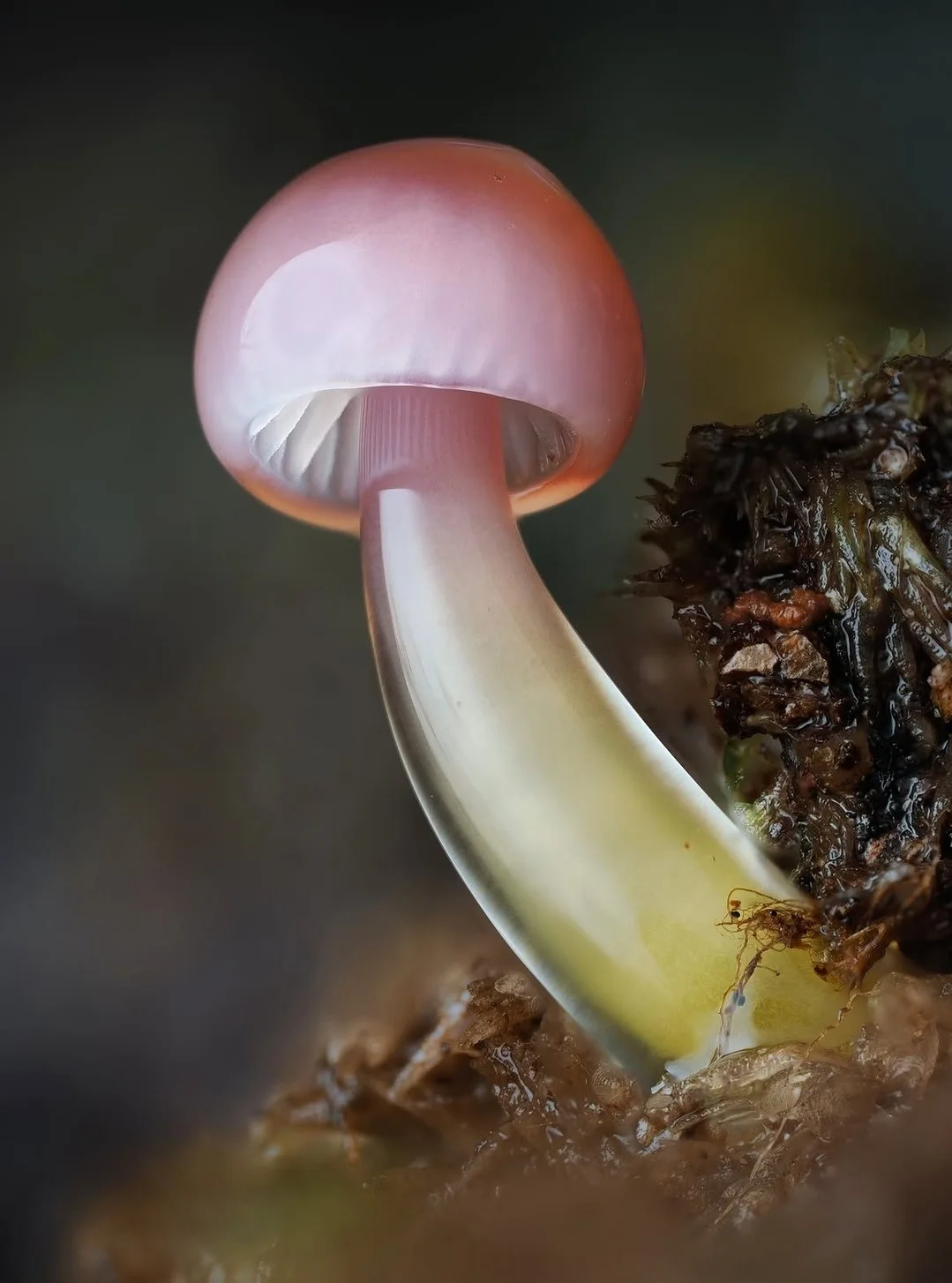
Post caption
Photo by @cyanesense
Even the smallest of fungi contain networks that are utterly expansive.
Many species are made up of microscopic, thread-like structures called hyphae, which can be as little as 2µm wide—a fraction of a strand of human hair.¹
In the case of the Gliophorus pictured here, the fungus’s hyphae form a gelatinous matrix that may help mushroom caps soak up moisture and resist drying.e²,³ Hyphal networks branch and expand, adjusting growth to local nutrients and conditions in their environment.⁴
¹ Metzen, I. E., & Bucher, M. (2026). Streamlining the isolation of fungal hyphae: A semi-automated approach for soil substrates. Journal of Experimental Botany, 77(15), 4857–4873. https://doi.org/10.1093/jxb/eraf539
² Harries, D. J., Blencowe, C. M., Leal-Dutra, C. A., et al. (2026). Revisions to the Gliophorus irrigatus complex (Agaricales, Hygrophoraceae, Gliophorus, section Unguinosae) including four new species, one new combination and comparisons of basidiome vs. eDNA distributions. MycoKeys, 127, 307–341. https://doi.org/10.3897/mycokeys.127.174823
³ Halbwachs, H., Simmel, J., & Bässler, C. (2016). Tales and mysteries of fungal fruiting: How morphological and physiological traits affect a pileate lifestyle. Fungal Biology Reviews, 30(2), 36–61. https://doi.org/10.1016/j.fbr.2016.04.002
⁴ Ledoux, C., Chapeland-Leclerc, F., Ruprich-Robert, G., et al. (2023). Prediction and experimental evidence of different growth phases of the Podospora anserina hyphal network. Scientific Reports, 13, 8501. https://doi.org/10.1038/s41598-023-35327-w
 Email