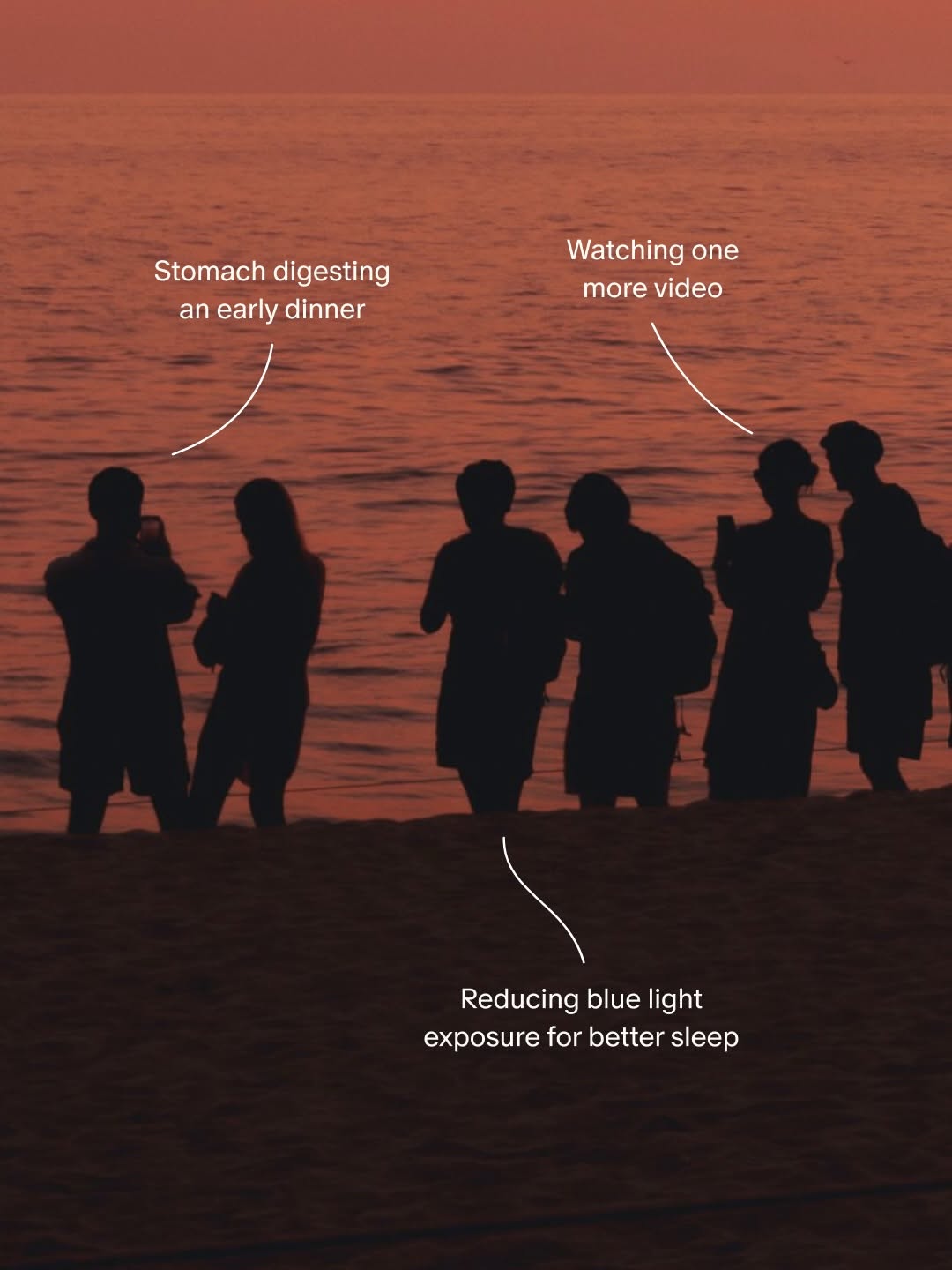
White labels and curved arrows annotate silhouetted people against an orange sunset, distributing everyday evening habits across two closely related photographs.
Post caption
POV: your evening routine is also a gut routine.
Light, food timing, stress, screens, and sleep all send signals to the body’s internal clock.¹,²,³ And because your gut microbiome has rhythms of its own, your nighttime habits can shape what happens in your body overnight.⁴
References
¹ Blume, C., & Münch, M. (2025). Effects of light on biological functions and human sleep. Handbook of Clinical Neurology, 206, 3–16. https://doi.org/10.1016/B978-0-323-90918-1.00008-3
² Calcaterra, G., Akurati, S., Punjabi, N., Iacobellis, G., & Varghese, R. T. (2026). “More kairos, less chronos”: Sleep, circadian rhythms and the path to cardiovascular, neurological and metabolic protection. Diabetes Research and Clinical Practice, 238, 113387. https://doi.org/10.1016/j.diabres.2026.113387
³ Ivankovic, I., Ramavath, H. N., & Cao, R. R. (2026). From cellular stress to systemic adaptation: The circadian clock and stress response at cellular and systemic levels. International Journal of Molecular Sciences, 27(17), 7918. https://doi.org/10.3390/ijms27177918
⁴ Zhao, Z., Wu, S., Wang, T., & Zhao, Y. (2025). Gut microbiota circadian rhythms: A key regulator of immunometabolic homeostasis. Acta Biochimica et Biophysica Sinica, 58(1), 106–119. https://doi.org/10.3724/abbs.2025220
 Email