
How Graza Pairs Squeeze and Refill

The bottle dispenses. The can replenishes. The funnel makes the handoff visible.
Graza connects two kitchen tasks: dispensing oil while cooking and replenishing an empty bottle. A can sized for the bottle, a funnel and instructions explain the transfer. The relationship between those objects makes the refill system worth studying.
Start with the dispensing habit.
Graza’s FAQ describes its squeeze bottles as chef-inspired and acknowledges that chefs have used the format for years. The useful adaptation is to sell the oil in a vessel already suited to that way of dispensing. There is no need to decant the first purchase before using the squeeze tip.
The names also divide the work. Sizzle is the cooking oil; Drizzle is the finishing oil. Those roles continue onto the refill cans. Someone choosing a refill can use the product name they already know from the bottle. The label has to distinguish replenishment from another ready-to-squeeze container, while preserving that connection.
This makes the second package part of the original product experience. A refill has to answer several practical questions: which oil is inside, which bottle it fills, how it opens and what else is needed to transfer it. The relationship between the two containers is the subject of the design.
Match the refill to the bottle.
Graza announced its can refills on May 9, 2024, with a debut online and in select Whole Foods Market stores. The current Duo Refill Cans page lists 500 mL for Drizzle and 750 mL for Sizzle. The brand’s explanation describes a one-can-to-one-bottle refill for those formats. These are specific size relationships, rather than a promise that every Graza bottle has the same capacity.
That match removes a decision from the refill moment: where should leftover oil go? The consumer still has to empty the correct can into the correct bottle, but does not have to portion an arbitrary bulk quantity for the stated pairings. It is a small piece of packaging arithmetic with an obvious role in the routine.
The can’s appearance needs to make that role clear. In Graza’s product photography, the olive characters and large wordmark carry over, while the pack says it is a refill. The design keeps the product recognizable as its dispensing format changes.
Show the step between the containers.
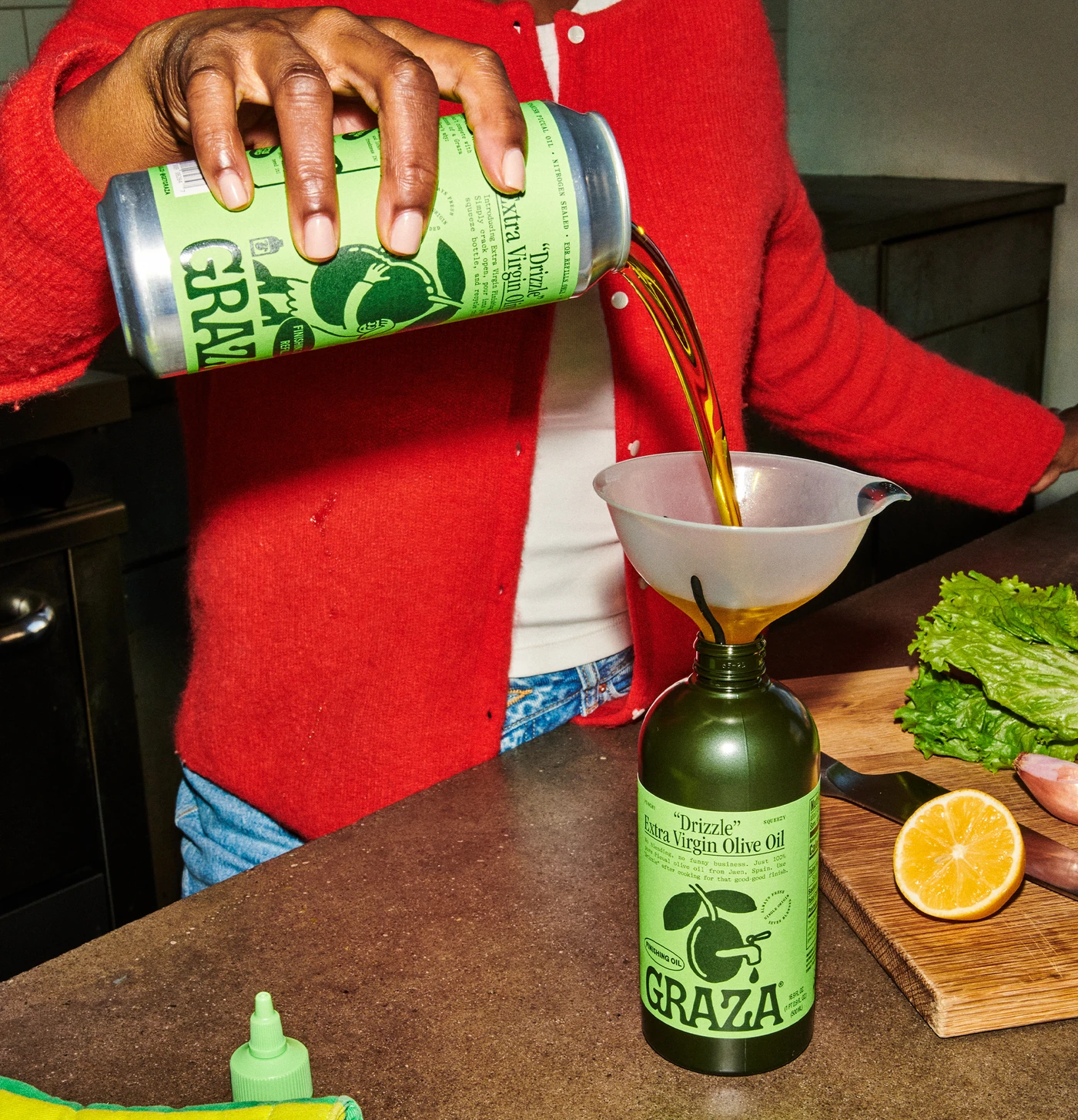
Graza’s instructions call for opening the can and pouring through a kitchen funnel into an empty squeeze bottle. Its Starter Kit brings the bottles, refill cans and funnel into one purchase. Including the transfer tool makes the extra step visible before the customer reaches an empty bottle.
The refill photograph shows why the funnel deserves attention. A hand tilts the can over the funnel, and the oil stream leads into the bottle opening. A still image can explain the relationship between the objects without a separate diagram. The can is doing a different job from the squeeze tip.
This is a useful test for any refill proposal: can the whole transfer be understood from the instructions and a clear demonstration? The review should include opening, holding, pouring and storing the necessary tool. An appealing replacement container leaves those tasks to be solved somewhere.
Keep convenience and performance claims separate.
Graza describes the cans as opaque and nitrogen-sealed, and presents those features as ways to protect the oil before use. Those are the brand’s packaging and freshness claims. We have not compared oxidation, shelf life or the environmental impact of its containers. A photograph of a refill cannot establish any of those outcomes.
A December 2025 r/Cooking discussion shows the practical appeal and the disagreement around the product. Some commenters praised the squeeze bottle and the refill’s exact fit; others questioned value or preferred glass and other oils. The thread offers individual experiences, not a representative judgment of taste, safety or willingness to refill.
The most useful lesson is the connection between the packages. Graza preserves the familiar dispensing object, gives replenishment its own format and explains the action linking them. A refill system becomes easier to assess when the brief includes that action, the matching quantities and the tools people need to complete it.